The reason why I chose endangered animals as my topic for my blog is because I have always been an animals lover and when I was really young I got a book all about endangered and extinct animals. That made me feel really sad that I never got to see the extinct animals and that the critically endangered animals might go extinct. From then on I really wanted to raise money to send to animals shelters and to sendmoney to other rescue centers. On this blog I am going to be talking about endangered animals around the world and how they are endangered and what we can do to help them. If you have any questions feel free to ask. Hope you will enjoy learning about endangered animals!
Endangered Animal #1.
Blobfish
 |
| Image From: http://endangered-ugly.blogspot.com/ |
Ever seen this animal? Probably not. This is called a Blobfish.Blobfish Basically what this thing is, is a dead specimen that looks so weird. The Blobfish's flesh is made out of gelatin-like substance in which has about the same density as water. Having this flesh allows it to float effortlessly in the water!
Ugly Endangered Animals #2
Matilda Horned Viper
The Matilda Horned Viper are critically endangered, therefore their location is mostly kept hidden from poachers to keep them safe. This snake was discovered in 2010-2011 it was finally claimed as a new snake on December 6,2011. This snake is a nocturnal animal, meaning that they sleep through the day and are awake hunting at night. This snakes favorite food to snack on are frogs.
 |
| http://images.nationalgeographic.com/wpf/media-live/photos/000/463/cache/new-species-matildas-horned-viper-extended_46391_600x450.jpg |
 |
| http://en.wikipedia.org/wiki/Leptodactylus_fallax#mediaviewer/File:Leptodactylus_fallax_%281%29.jpg
Endangered Animal #3
Giant Ditch Frog lives in the Caribbean. In the last 10 years the population of the Ditch Frog has declined by 80% since 1995, which now makes them critically endangered. Locally, the Ditch Frog is known as the Mountain Chicken. Why? Because their size is massive and it is commonly hunted for food.
The Giant Ditch Frog is one of the largest frogs in the world, The females can grow up to 21 centimeters long! The Ditch Frog will come in many different colors. They can come in a chestnut-brown or barred or even spotted in the upper half, and orange-yellow on the sides of the body, pale yellow is what you might see on the underpart. They have a large head with massive muscles.
The Giant Ditch Frog used to be all over the Caribbean but now they are restricted to Dominica and Montserrat. The Giant Ditch Frog like to live in dense forests and hillside plantations,river valley and flooded forests. They are most always found near streams and springs.
|
The South Asian river dolphin.
This dolphin is a freshwater dolphin found mainly in India,Bangladesh, Nepal and Pakistan.
How do you know which dolphin is the South African river dolphin? Well the River Dolphin is the one with the long, pointed nose.You can see the teeth in both the upper and lower jaws especially with the mouth closed. One thing that you might not know about these dolphins is that they are blind. The lens in their eye only makes the things that they are seeing shadows. How are they able to hunt for food? They use something called echolocation. Echolocation is when the animal sends high pitched sound waves though the environment. If there is an object in front of them then the sound waves will bounce off of the object right back to the animal, who will then either avoid the object or if its food,go and eat it. Not only dolphins use echolocation; bats, whales, and some birds will also use it as well.
The South African River Dolphin

Endangered Animal #5
Tasmanian Devil
Tasmanian Devil has a reputation just like every other animal. As the largest marsupial predator alive, the Tasmanian devil will just about eat anything smaller than its self. If you look at the Tasmanian devil at first sight, you might think that "Devil" is too harsh for such a creature. I'm sorry but you might have underestimated the devil. For while it might look all cute and innocent. But at night when it becomes a scavenger and a ferocious fighting marsupial. Then "Devil" is the perfect word to think of.
The Tasmanian devil is the largest surviving carnivorous marsupial. A marsupial is a mammal who has been born incompletely. Therefore, the mother has to carry them around in a pouch until they are completely grown up.
 |
| http://www.abc.net.au/radionational/programs/drive/tasmanian-deviljpg/4372058 |
Now to discuss about they body. They have a thick build, with a massive head and tail which takes about half of their body length .Usually on a marsupial the front legs are slightly longer then the back legs. Fun Fact is that the devils can run pretty fast at 8 mph but only for short distances. Their fur is mostly always black but with occasional white patches.Males are usually larger than females. Devils have 5 toes on their forefeet. They would have four toes pointing towards the front and one jutted out out to the side. One really neat fact about a devils foot is that they have NO retractable claws! The hind feet then have 4 toes.
Either way this is one animal you do not want to make friends with.
Endangered Animal #6
Porbeagle
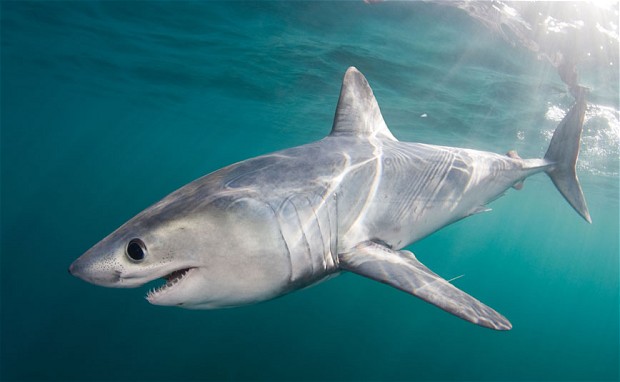
The Porbeagle is a very stout-bodied shark with a spindle like shape. The snout is supported by enlarged cartilages. The eyes are large and black without protecting the eyelids. The small nostril ls are in front and below the eyes. The mouth is large and curved with huge jaws. inside of that jaw. each tooth in the mouth has a strong base and a central cusp.
Now to discuss the body along with the fins.The pectoral fins are long and narrow and the first dorsal fin is large and high/ The pelvic fins however are much smaller than the first dorsal fin. The second dorsal and the anal fin are very small. The skin of the shark is soft and covered by tiny scales in which will give you the velvety texture.
Porbeagle
 |
| http://www.sharknewz.com/wp-content/uploads/2013/03/Porbeagle1.jpg |
Endangered Animal #7
Island Tenebrionid Beetle
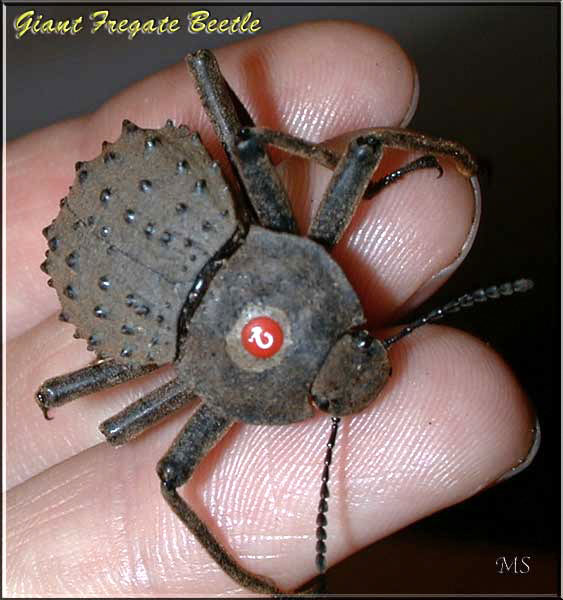
This is an Island Tenebrionid Beetle, better know as the Darking Beetle. It is said that this is the largest known tenebrionid in the world. A tenebironid is a Darking Beetle and their larvae are the well known meal worms. Before I get started on the beetle let me just say that in your daily life and you see a meal worm is means that either you have a wonderful pet meal worm in your house you you have a lovely meal worm in some flour that has been sitting in your pantry forever.
Island Tenebrionid Beetle
This is an Island Tenebrionid Beetle, better know as the Darking Beetle. It is said that this is the largest known tenebrionid in the world. A tenebironid is a Darking Beetle and their larvae are the well known meal worms. Before I get started on the beetle let me just say that in your daily life and you see a meal worm is means that either you have a wonderful pet meal worm in your house you you have a lovely meal worm in some flour that has been sitting in your pantry forever.
 |
| http://endangered-ugly.blogspot.com/search?updated-max=2008-12-23T03:08:00-05:00&max-results=7&start=21&by-date=false |
All right. Now I can discuss their habitat and their body. They live on the Frigate Island Beetle itself in which is north of Madagascar. . In the picture they may look small but that is NOT a small beetle but really? Their length is 20-30 mm and they are completely flightless and do not get around much. They spend their whole day on a few dead trees in a small are. If they do go anywhere scientist have recorded this beetle traveling at "its" absolute farthest at 19 meters.
Endangered Animal #8
Pangolin
For this post I want to express my feelings towards the poor Pangolin. There are 8 different types of species of a pangolin. All but 2 are expressed by ICUN as threatened to extinct. The remaining 2 are labeled as critically endangered.
Pangolin
For this post I want to express my feelings towards the poor Pangolin. There are 8 different types of species of a pangolin. All but 2 are expressed by ICUN as threatened to extinct. The remaining 2 are labeled as critically endangered.
1st I'm going to discuss how the pangolin is built. I has large, hard, and overlapping scales. The scales are will start of soft but as the pangolin grows up they will soon harden the scales are made of of the material of a human fingernail! The pangolin's body can be compared to a pine cone or a artichoke. This is part of its defence. When threatened the pangolin will curl up in a ball and with its overlapping scales it will tend to look like a pine cone. The scales are sharp as well so it will also provide extra good defense.
Cute Pangolion
Cute Pangolion
 |
| http://champagnewhisky.com/2014/02/15/the-happy-pangolin/ |
Another thing I would like to point out is that a pangolin is much like a skunk! You might not believe me but they can spray a noxious-smelling acid from the glands close to the anus. This gives some proof that they are close to the skunk. The Pangolin have short legs and amazing sharp claws in which they will use for burrowing into termite or ant mounds.
 Now I would like to discuss why they are on my endangered list. If you look at the picture to the left of the screen that I am about to insert you will see a shape that looks sort of like a rat. That is a pangolin. They will be killed then put in soup especially in China. Pangolin soup is much wanted in China because the chinese think of them as a delicacy. Some chinese will also use the scales as part of medicine as well they are also wanted because of their scales. People will use their scales and make clothes out of them like this coat here.

This I believe is a serious issue so I'm glad that you are all aware of t
Now I would like to discuss why they are on my endangered list. If you look at the picture to the left of the screen that I am about to insert you will see a shape that looks sort of like a rat. That is a pangolin. They will be killed then put in soup especially in China. Pangolin soup is much wanted in China because the chinese think of them as a delicacy. Some chinese will also use the scales as part of medicine as well they are also wanted because of their scales. People will use their scales and make clothes out of them like this coat here.This I believe is a serious issue so I'm glad that you are all aware of t
Hi. So today I thought that instead of discussing about an endangered animal I have decided to go slightly personal about how I became interested in endangered animals.
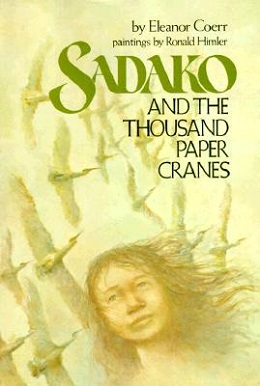
When I was really young my parents have influenced me a lot by giving me little stuffed animals and then when I got older I was given a book full of extinct. I was reading through it and realized I had no idea that all of these animals were extinct. I then looked up endangered animals and soon fell in love with a lot of the animals that were endangered.After that I decided that I really wanted to do something to help.
 |
| http://en.wikipedia.org/wiki/Sadako_and_the_Thousand_Paper_Cranes#mediaviewer/File:Sadako_and_the_thousand_paper_cranes_00.jpg |
But I don't want to spoil the story and that isn't even my anecdote. But after reading that book I really wanted to to something similar like Sadako. But instead of keeping them I wanted to sell them. I started when I was in 3rd grade and I still am trying to keep that up. I really want to get to 1,000 and then I plan to sell them all,and with all the money I plan to give it to a rescue center or animal shelter.
 I think that this book is a really inspiring story, and this is what inspired me to research more about extinct and endangered animals.
Top 10 of what we should do to help the endangered animals
- Throw away our garbage in the garbage can not on the ground. This will help because if you throw it on the ground, an animal may mistake it for food and they can become very ill.
- If you are on a beach pick up after yourself because if you don't a seagull or other animal can eat it as food.
- Don't feed wild animals food
- Don't plan on poaching any animals
- Try to avoid using plastic because if the plastic gets out in the ocean a sea animal can get tangled and strangled in it and may suffocate to death.
- Help your community center. See if you can volunteer at the beach.
- Try to raise money to donate to local shelter. This way they can buy food or spend it in any way to help the animals.
- Volunteer at a local animal shelter. This way you can have fun while keeping an animal entertained. If you don't some animals will get sick and die of loneliness.
- Get involved. If you get involved it will really show that you are trying to help the world.
- HAVE FUN while learning and helping! Make sure that if you do decided to help out at a volunteer shelter or community make sure you do something that you will enjoy.
 |
| https://blogger.googleusercontent.com/img/b/R29vZ2xl/AVvXsEjX89ZOXnWRqaG5UaEFD624gkLcM8VsuaTQGK56p1VmEI1f_psWySJ8j3XEQs55IGtViDXx1bKQOyGC0tvbnNQwk_3cWBRbVos0hMHCPQVqwH0L8WFO_WoyGJE2ydhj5RvF2RnY79InSdNV/s640/Proboscis_Monkey.jpg |

No comments:
Post a Comment